Project
Fibre Spinning Plant
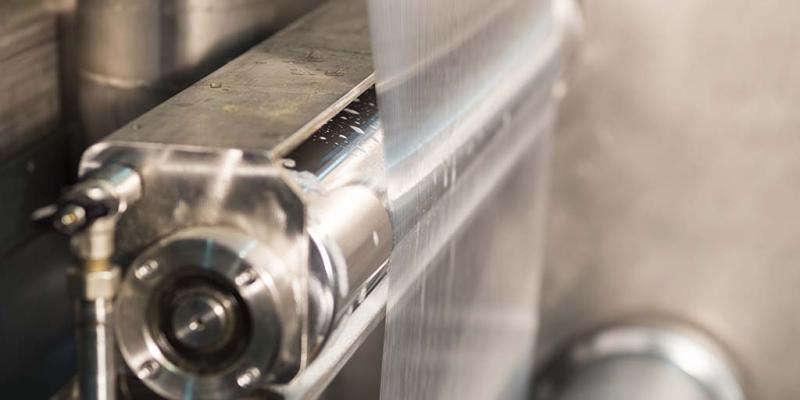
Antefil's patented technology coats individual glass filaments with thermoplastic during spinning, a cleaner and faster route to lightweight composites. I helped scale the fibre-spinning plant from lab to pilot production and optimised the drying channel, which is the main determinant of final fibre quality.
Parametric Design & Scale-Up
Used parametric skeletal modelling to make plant components scale-independent. A single parameter change (fibre angle, mandrel diameter, channel geometry) updated the full assembly and drawings, cutting iteration time as Antefil moved to pilot scale.
Airflow Optimisation
The drying channel is where fibre quality is made or lost. Non-uniform airflow causes inconsistent coating thickness and degraded mechanical properties in the final composite. I used CFD/FEA to redesign the airflow distribution, improving thermal uniformity and process stability across thousands of simultaneously spun filaments.
Lab → Pilot
Scale-Up
CFD
Airflow Redesign
Parametric
Plant Modelling
Challenges
- Thousands of filaments pass through the drying channel simultaneously. Small airflow non-uniformities create coating variations that compound into measurable defects in the final composite.
- Scale-up is not just making the equipment bigger. Flow dynamics, thermal profiles, and residence times all change non-linearly with scale.
Outcomes
- CFD-driven redesign improved drying uniformity, contributing to consistent fibre quality at pilot scale.
- Parametric models let the team evaluate different production scales without rebuilding assemblies from scratch.