Project
Eagle
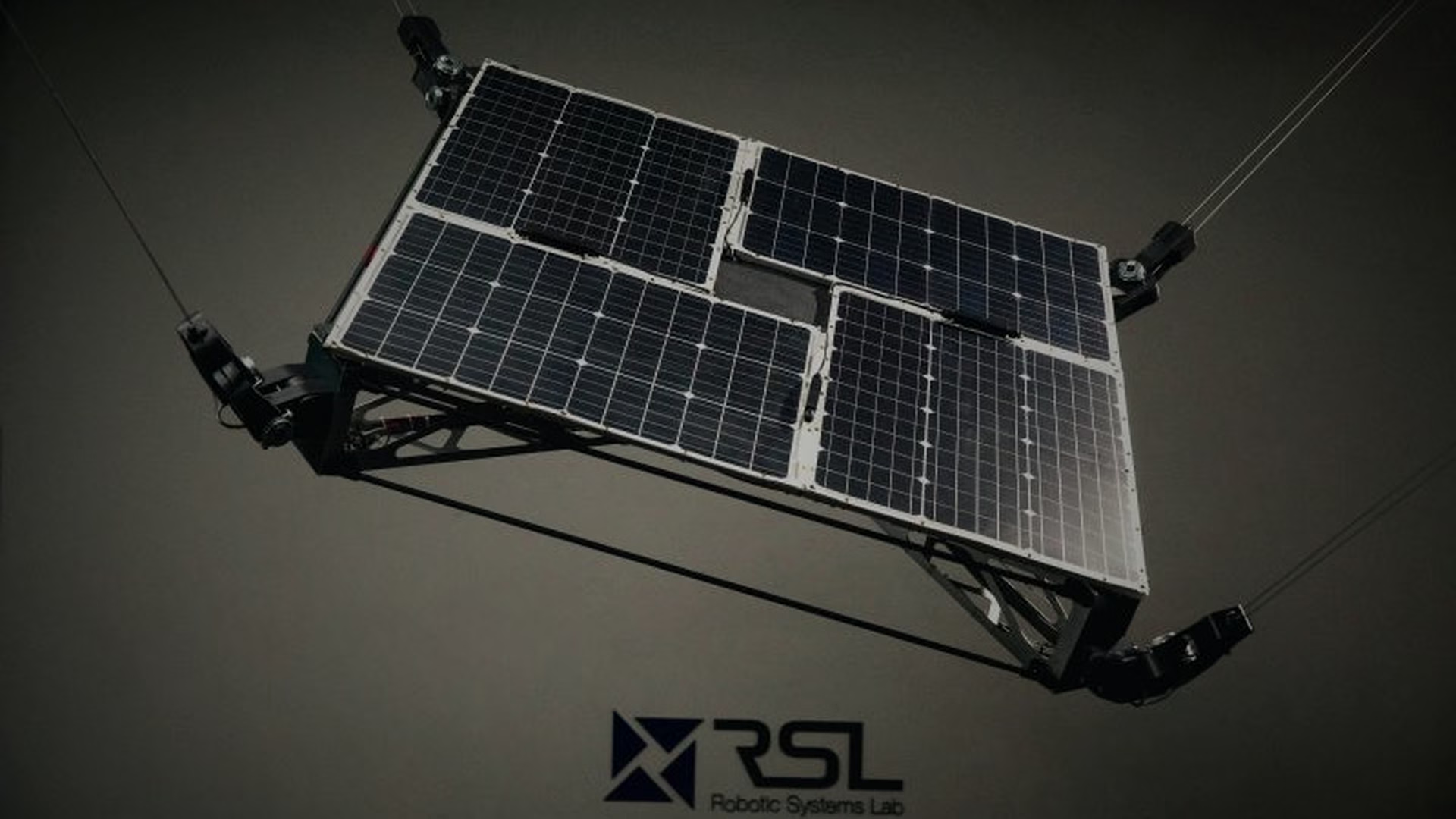
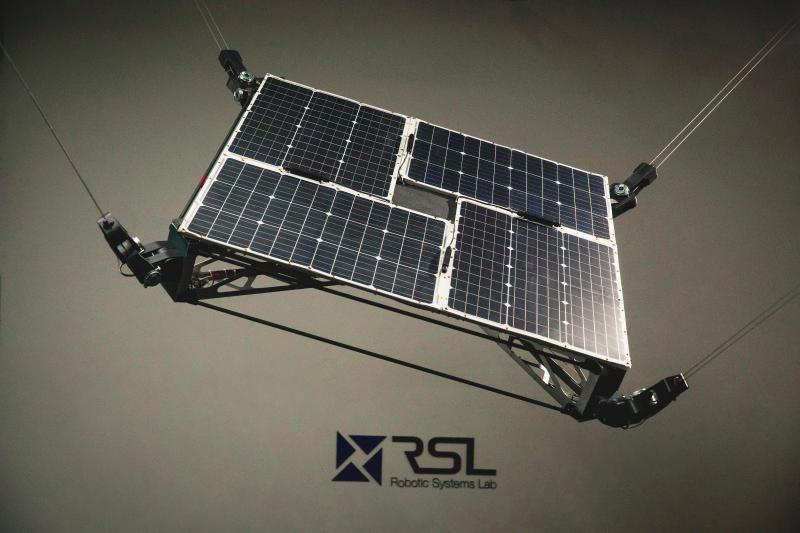
My master thesis: a cable-driven parallel robot I designed from scratch and took from concept to field-tested prototype in 6 months. The core innovation is a 'Coupled Drive' mechanism that shares torque between actuators, a first in cable robotics. Presented at Swiss Robotics Day 2021. Thesis grade: 6.0/6.0.
Coupled Drive Mechanism
A Coupling Matrix (Q_c) interconnects actuators and cables so each motor contributes to multiple cable tensions at once. Conventional cable robots use one motor per cable; the coupled drive shares torque across actuators, cutting peak motor requirements and energy consumption substantially. This was essential for an aerial platform carrying a Kinova Gen2 arm, a solar panel, and a harvesting payload over steep terrain.
Structural Optimisation & Field Testing
Mass budget is tight on a flying platform. Topology optimisation across all structural subsystems (wings, rope drums, actuator brakes, body frame) delivered a 40% mass reduction while keeping full structural safety under flight loads, with each component FEA-validated against cable tensions, payload inertia, wind disturbance, and the dynamics of a robot arm on a suspended platform. Subsystems were manufactured via SLA, SLS, and CNC machining; field tests demonstrated hovering, external load-disturbance recovery, elevation control, and workspace scanning. Results presented at Swiss Robotics Day 2021.
6 mo
Concept to Field Test
40%
Mass Reduction
6.0/6.0
Thesis Grade
Challenges
- Conventional direct-drive actuators were too heavy for an aerial platform. The project depended on finding a way to share torque across motors, an approach not previously demonstrated in cable robotics.
- Rope friction across coupled drum mates made force control highly non-linear, diverging from the theoretical coupling matrix.
- Every structural component had to be mass-optimised to its limit while still carrying a robot arm, solar panel, and harvesting payload over uneven terrain.
Outcomes
- First demonstration that actuator coupling works as a drive mechanism in cable-driven parallel robots: a new contribution to the field.
- 40% mass reduction across structural subsystems through topology optimisation, validated by FEA and physical load testing.
- Concept to field-tested prototype in 6 months. Swiss Robotics Day 2021. Thesis grade: 6.0/6.0.