Project
AXIOM-1000
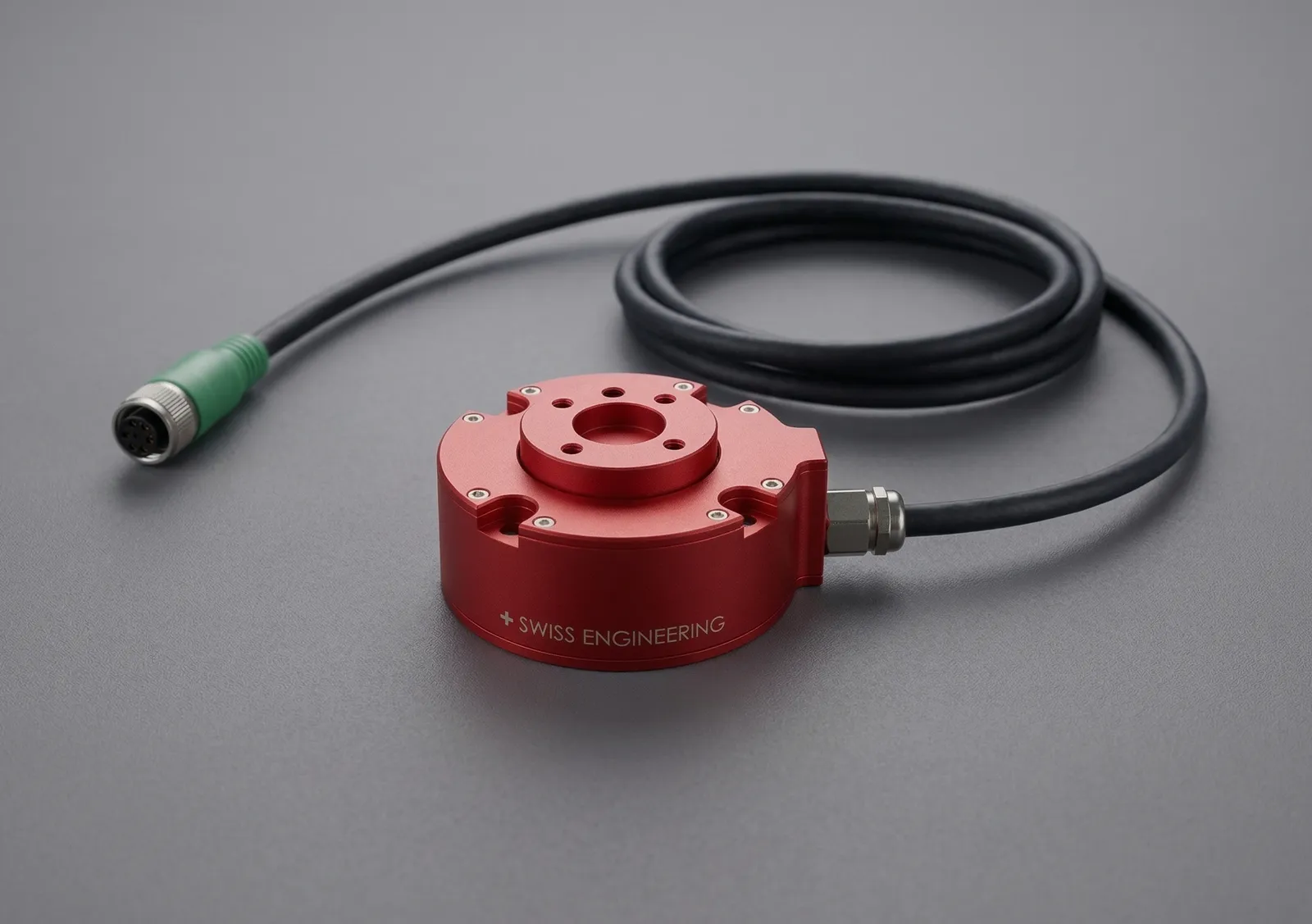
The AXIOM-1000 is a 6-axis force-torque sensor: 250 g, 70 mm × 40 mm, IP67-sealed, single-cable RS-485, no external interface box. It is the mid-range reference model in X-Tech Studio's multi-variant product line in Zurich.
Monolithic Sensing Architecture
The sensing element is a monolithic aerospace-grade aluminium body, designed for low hysteresis and high repeatability. It measures ±1,000 N (Fx/Fy) and ±3,000 N (Fz) at 50 mN resolution, and ±50 Nm torque at 1 mNm resolution. On-board calibration transforms, offset correction, and sub-100 µs force-to-data latency, in a 250 g IP67 package.
Product Line & Industrialisation
I architected the full product line around the AXIOM-1000: ±500 N to ±5,000 N, in standard solid-body and hollow-shaft (AXIOM-HS) form factors with central through-bores for cable routing. All variants share a common electronics and firmware platform to keep NRE low. I coordinate the mechanical, electronics, and software work, and hold each design to a common BOM structure, shared tooling, and a single assembly process.
250 g
Sensor Mass
50 mN
Force Resolution
<100 µs
Latency
Challenges
- Building a sensor company from zero: defining the product, architecture, supply chain, and go-to-market in parallel, with no existing team or infrastructure.
- Fitting sub-100 µs embedded signal processing into a 250 g single-cable package, with no external interface box, while keeping BOM cost competitive with established players.
- Designing a common sensing architecture that scales across four force ranges and two form factors without giving up performance at any point in the range.
Outcomes
- Pre-production units in active pilot deployments for precision assembly, material processing, and humanoid robotics.
- Complete product line from ±500 N to ±5,000 N with RS-485, EtherCAT, CAN, and WiFi, covering the protocols customers actually use.